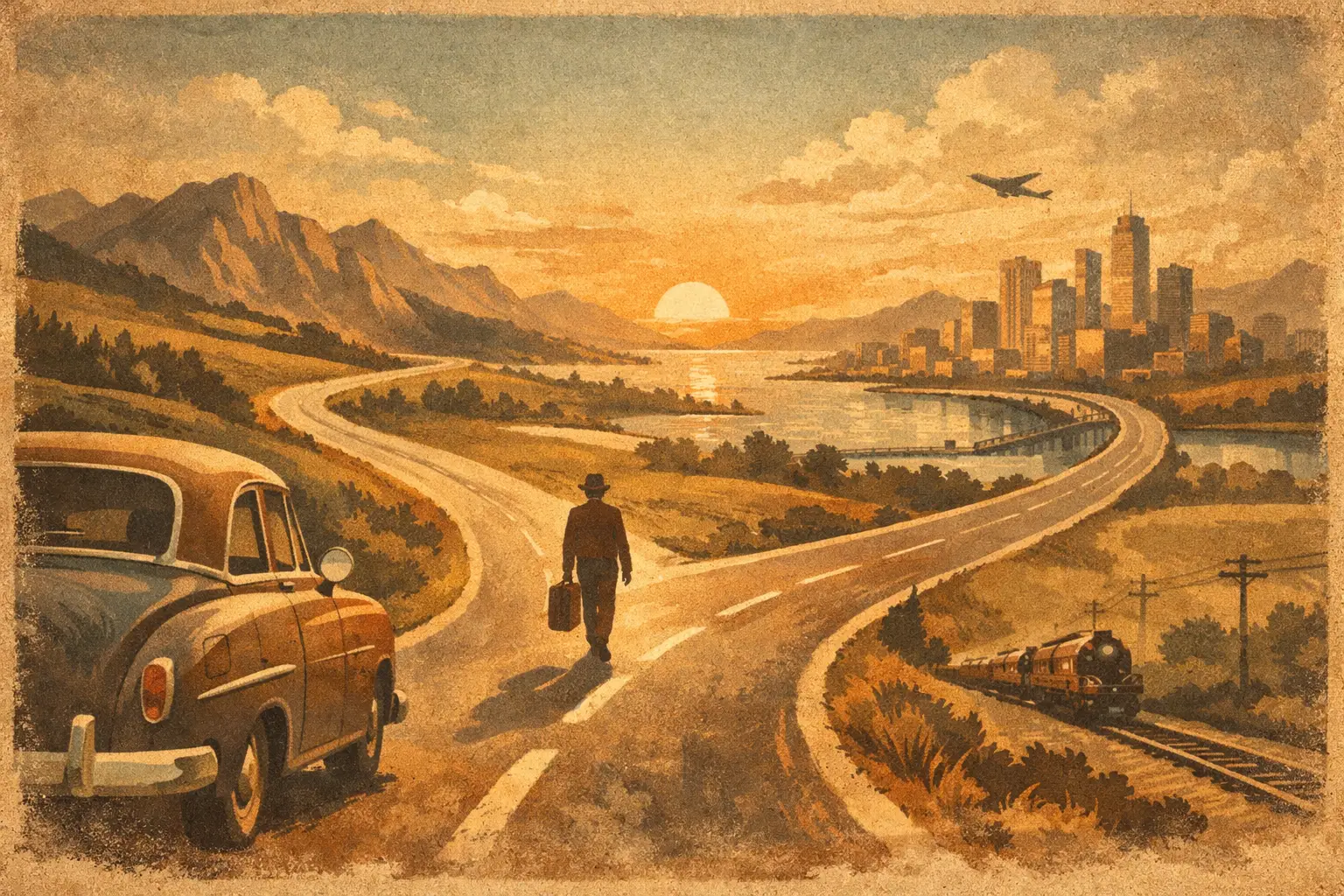
A road does not merely connect one place to another. It measures hesitation, endurance, and the subtle reshaping of the self that happens between departure and arrival. In a journey shaped by road distance and arrival, miles are never neutral. They gather weight. They test intention. They turn landscape into a kind of thought.
This is one of fiction’s oldest recognitions and still one of its richest. The farther a traveler moves, the less the road remains a background detail and the more it becomes an active force. Dust on clothes, the repetition of stones, the slow shift of light across a ridge, the bells carrying across the air from a settlement still unseen – these details create more than atmosphere. They establish the terms of transformation. A character who arrives after real distance does not simply enter a new place. That character has been prepared, worn down, sharpened, or altered by the way there.
Why road distance matters in a journey shaped by road distance and arrival
In literary fiction, distance creates meaning because it imposes time. Time allows expectation to accumulate and perception to deepen. A short route can still matter, of course, but long roads produce a special pressure. They make room for doubt, ritual, memory, and re-interpretation. The traveler begins with one idea of the destination and often reaches it with another.
That interval matters because arrival is rarely just geographic. It is emotional, cultural, and sometimes spiritual. If a village appears only after days of heat and silence, its gates, wells, or towers carry a different charge than they would if reached in ten minutes. Distance gives the place gravity. It lets the reader feel that entry has been earned, or perhaps exacted at a cost.
There is also a structural consequence. When writers treat road distance seriously, pacing changes. The story resists instant access. It understands that what lies between points matters as much as the points themselves. For readers drawn to setting-driven work, this can be one of fiction’s deepest satisfactions. The world does not feel sketched in for convenience. It feels inhabited, measured, and real.
Arrival is never only the end
Arrival often appears to be the goal, but in strong narrative design it acts more like a threshold. The road promises completion. The destination reveals complication. What looked final becomes interpretive.
This is why memorable arrivals tend to contain both clarity and disturbance. A character may reach the city, the shrine, the house, or the border and find not resolution but a new arrangement of uncertainty. The distance traveled has built expectation. Arrival then tests whether that expectation can survive contact with place.
Sometimes the result is intimacy. A long-awaited place is finally seen in actual light, with its weather, textures, and local order. Sometimes the result is estrangement. The imagined destination collapses against the reality of walls, customs, dialects, and power. Either way, arrival gains force because the road has prepared the reader to experience it not as information, but as impact.
This is especially true in novels where place behaves almost like a sentient presence. A settlement can feel watchful. A road can feel ceremonial. A mountain pass can narrow not only physical movement but thought itself. In such work, arrival is an encounter with an already-existing system, quiet and carefully made, into which the traveler must enter without controlling it.
The road as a maker of identity
One reason the motif endures is that road distance exposes the instability of identity. Away from familiar structures, people become porous. They remember differently. They speak differently. They begin to negotiate with hunger, fatigue, weather, and strangers.
This does not mean every road story must be dramatic or visibly perilous. Some of the most affecting transformations are almost imperceptible. A traveler learns how to listen to silence. Learns that a map is not the same as terrain. Learns that the body keeps its own record of distance, one that cannot be argued away by intention. These changes are quiet, but they matter. By the time arrival comes, the person who arrives is not identical to the person who left.
For literary readers, this is where the road becomes more than plot machinery. It becomes a method of knowing. Identity is not announced through explanation alone. It is tested by movement across space. The self is revised in relation to ground, season, and threshold.
Place must answer the distance
Not every fictional destination deserves the road that leads to it. That is one of the central trade-offs in a journey built around movement. If a writer asks the reader to inhabit distance, the arrival must offer density in return.
Density does not mean spectacle. It means specificity. A place should feel governed by its own customs, textures, sounds, and concealed tensions. If the road is long but the destination generic, the narrative contract weakens. But when arrival opens onto a place with ritual logic and sensory authority, the reader understands why the distance mattered.
This is where setting-driven fiction distinguishes itself from thinner adventure narratives. The destination is not a reward image. It is a world with memory. Its surfaces suggest prior lives, layered beliefs, and forms of order the traveler does not immediately grasp. Stone, market noise, incense, shadow, a stair worn hollow by generations – these details do not decorate the scene. They establish that arrival has entered history.
Reading a journey shaped by road distance and arrival
Readers who gravitate toward atmospheric fiction often read roads differently from readers seeking speed alone. They do not ask only, What happens next? They also ask, What is the journey teaching me to notice? A road chapter can reveal cosmology, class, power, geography, and fear long before any direct explanation appears.
This slower attention is not for everyone, and it does not need to be. There is always a balance to strike between motion and contemplation. Too much emphasis on distance without evolving tension can flatten a story. Too little, and arrival loses force. The strongest novels understand rhythm. They let repetition work, but they interrupt it with omen, encounter, or revised understanding.
When done well, road distance creates a rare kind of readerly immersion. The destination is not consumed as a twist. It is approached with layered anticipation. The reader arrives not only informed, but conditioned – made ready by time, weather, and the patterned discipline of movement.
Why this theme remains powerful now
Part of the theme’s endurance comes from how sharply it resists immediacy. Modern life is organized around compression. Routes are optimized. Waiting is treated as waste. Fiction can restore a more difficult truth: delay changes meaning.
A place reached too quickly may remain shallow in the mind. A place reached through hardship, ambiguity, or sustained attention enters more deeply. This is true in narrative and often in life. Distance creates proportion. It teaches the traveler what can and cannot be carried.
That is one reason novels centered on atmosphere, ritual, and transformation continue to matter. They understand that movement through landscape is also movement through interpretation. In a work such as PAI, where journey and place carry thematic weight, the road is not filler between major scenes. It is one of the major scenes. It is where belief is strained, where the world begins to disclose its terms, and where arrival acquires moral and symbolic consequence.
What arrival leaves behind
The most affecting arrivals do not erase the road. They retain it. Dust remains on the hem. Fatigue alters the first conversation. The body’s memory of distance shadows the threshold crossing. Even when a destination offers shelter, revelation, or temporary peace, the road continues to speak through the one who has traveled it.
That lingering matters because it keeps the narrative honest. Real change rarely appears as a clean break. Arrival does not close the journey as much as reveal what the journey has done. The traveler sees the place, yes, but now sees the self against it.
And that may be the lasting power of a journey shaped by road distance and arrival. It asks us to treat movement not as empty transit but as form, pressure, and preparation. It reminds us that the places worth reaching are often the ones that teach us how to arrive before we ever see their walls.
Leave a Reply