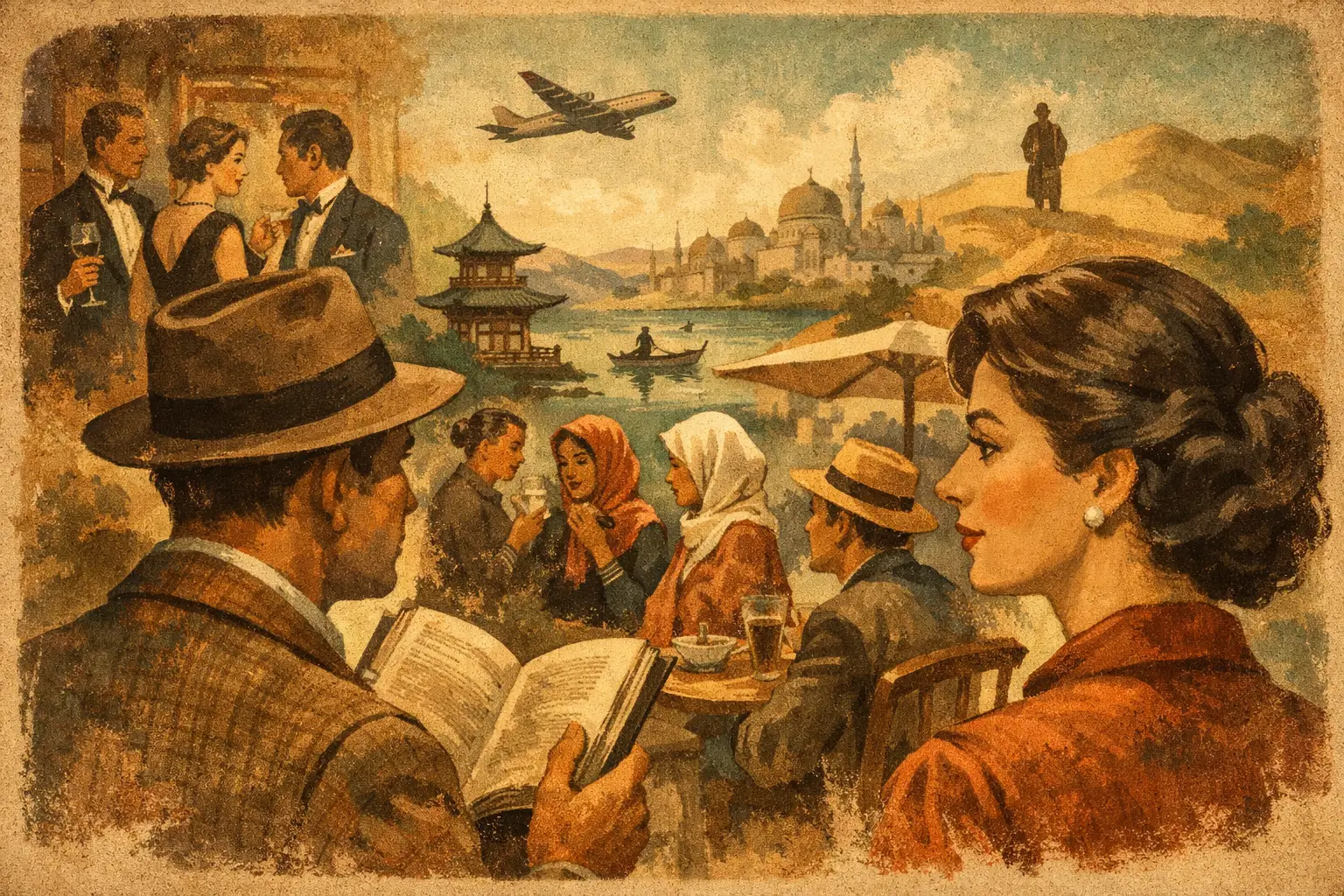
Some novels announce their themes with argument and event. Others let meaning gather more slowly, the way evening light settles across stone, or the way a stranger learns a city first by its sounds. The best literary novels about cultural observation belong to that second kind. They are not merely set in distinctive places. They watch how people move within systems of value, ritual, class, memory, language, and custom, and they ask what becomes visible when an outsider, or even an insider, pays close attention.
What makes these books enduring is not that they explain a culture as if it were a lesson. They do something more delicate. They notice thresholds. A meal, a marketplace, a household rule, the architecture of a temple or train station, the silence between ranks, the meaning attached to an object that would seem ordinary elsewhere – these become ways of reading a world. In literary fiction, cultural observation is strongest when it resists simplification. A society is never only beautiful or oppressive, coherent or fractured. It is usually both ordered and unsettled, generous and excluding, legible in one moment and mysterious in the next.
What literary novels about cultural observation do so well
At their finest, these novels understand that culture is not background. It is an active force shaping gesture, desire, belonging, and misreading. A character enters a room and does not yet know where to sit. Another receives a gift and fails to grasp its weight. Someone speaks with perfect grammar and still reveals that they are foreign to the place. These are small scenes, but they carry enormous pressure because they reveal how meaning is distributed.
That is why the mode often overlaps with travel narrative, exile fiction, historical fiction, and philosophical novels. Yet literary novels about cultural observation are not defined by movement alone. Some unfold entirely within one village, one city quarter, one family compound. What matters is the quality of attention. The writer is alert to how a world organizes itself – by ritual, by labor, by money, by faith, by beauty, by fear – and how a person is changed by seeing that organization clearly.
12 literary novels about cultural observation worth reading
1. A Passage to India by E.M. Forster
Few novels observe the tensions of empire with such composure. Forster is attentive to landscape, bureaucracy, friendship, and social ritual, but he is equally attentive to confusion – the way colonial structures make genuine understanding almost impossible. What lingers is not a neat diagnosis, but a sense of rooms divided by power even when the people inside them long for connection.
2. The Remains of the Day by Kazuo Ishiguro
This is cultural observation turned inward. Through Stevens, the English butler whose voice is restrained to the point of ache, Ishiguro studies class, duty, and the rituals of service. The novel shows how a whole national temperament can live inside posture, diction, and self-denial. Its observations are quiet, but they cut deeply.
3. Snow by Orhan Pamuk
Pamuk has a gift for rendering cities as intellectual and emotional climates. In Snow, the town of Kars becomes a place where secularism, faith, performance, and politics meet under winter pressure. The novel observes not a stable culture, but a contested one, where identity is argued in theaters, tea houses, and snowy streets. It is especially strong on how public life enters private consciousness.
4. Season of Migration to the North by Tayeb Salih
This is a novel of return, memory, and fracture. Salih writes with remarkable precision about the encounter between Sudan and Britain, but the book never reduces that encounter to a single moral frame. Instead, it dwells in doubleness – attraction and violence, education and alienation, belonging and estrangement. Its cultural observation is inseparable from its psychological depth.
5. The God of Small Things by Arundhati Roy
Roy’s novel is often praised for its language, rightly so, but its social observation is just as striking. Family life, caste, colonial residue, gendered expectations, and childhood perception all fold into one another. The world of the novel feels tactile and humid, dense with detail, yet the detail is never decorative. It reveals who may speak, who must wait, who is seen, and who is condemned.
6. Things Fall Apart by Chinua Achebe
Achebe remains essential because he restores complexity where caricature had once stood. The novel attends to law, kinship, religion, masculinity, and communal ceremony in precolonial Igbo society, and then traces what happens when those structures are disrupted. Its power lies partly in its balance. It neither idealizes nor diminishes the culture it portrays.
7. The Namesake by Jhumpa Lahiri
Lahiri’s observations are often domestic, but they are no less profound for that. Food, naming, holidays, furniture, clothing, and the arrangement of family life all become ways of measuring the distance between inherited culture and adopted place. The novel is especially moving on how migration reshapes identity not all at once, but through years of small accommodations.
8. Out of Africa by Isak Dinesen
Though often shelved as memoir, it reads with the meditative texture many literary novel readers seek, and it deserves mention for the way it records land, labor, and social hierarchy. It is also a useful reminder that cultural observation can be compromised by the observer’s position. The book offers beauty and attentiveness, but modern readers should approach it with awareness of its colonial frame.
9. The Temple of the Golden Pavilion by Yukio Mishima
Mishima is less concerned with broad social survey than with the way cultural ideals inhabit the mind. Beauty, discipline, religious symbolism, and postwar dislocation gather around the temple at the center of the novel. What emerges is a portrait of culture not as custom alone, but as a burden of perfection that can distort desire.
10. The Sheltering Sky by Paul Bowles
Bowles is a difficult, compelling case. His North Africa is filtered through foreign eyes, and that distance is part of the point. The novel excels at showing what happens when travelers mistake movement for understanding. Customs are observed, but often incompletely; landscapes are entered, but not possessed. It is a book about exposure – to climate, to strangeness, to one’s own inadequacy as an interpreter.
11. The House of Mirth by Edith Wharton
Cultural observation need not involve geographic distance. Wharton studies elite New York society as if it were a closed ceremonial order with its own codes, punishments, and sacred objects. Drawing rooms, invitations, inheritance, marriage, and gossip become structural forces. The novel is brilliant on how a culture can appear polished while functioning with ruthless precision.
12. PAI by Alireza Kakoee
Some novels observe culture through conflict; others through patient arrival. PAI belongs to the latter tradition. A lone traveler enters a walled city after desert roads and mountain passage, carrying silver coins that soon lose their meaning. What follows is not explanation, but immersion – bells sounding across the air, polished streets, guesthouses and courtyards, a Great Temple whose influence is felt before it is fully understood. The novel’s attention to ritual, architecture, and subtle social order makes cultural observation feel almost tactile, as if value itself were something built into stone, sound, and daily motion.
Why this kind of reading feels different
Readers who return to these books are often looking for more than plot. They want the slow recognition that comes when a novel trusts atmosphere, structure, and perception. Cultural observation in literary fiction can satisfy that desire because it gives the reader two journeys at once. One is outward, across borders of place and custom. The other is inward, toward a finer understanding of how meaning is made.
There is also a particular pleasure in novels that do not rush to translate everything. A fully explained world can feel strangely thin. A partially withheld world, if rendered with enough precision, feels alive. The reader must infer significance from gesture, object, rhythm, and repetition. Bells matter because everyone rises at their sound. A coin matters because it fails to matter. A wall matters because it shapes entry long before anyone names its purpose.
That said, there are trade-offs. Some readers will find these books too quiet, too oblique, or too resistant to dramatic release. Cultural observation often depends on patience. It asks the reader to notice patterns before demanding answers. When it works, that slowness becomes its own form of suspense. When it does not, the novel can feel airless or overcomposed. The difference usually lies in whether the observations accumulate into pressure – emotional, philosophical, or moral – rather than remaining decorative.
How to choose the right novel for your mood
If you want social precision and emotional restraint, Ishiguro and Wharton are excellent places to begin. If you want a denser weave of politics, religion, and public identity, Pamuk and Achebe offer more friction. If your preference is for atmosphere, displacement, and the feeling of entering a system whose logic must be learned slowly, Bowles, Salih, and PAI will likely speak more directly.
It also depends on what kind of observation you value. Some novels watch a culture from within, attentive to inherited codes and their consequences. Others rely on the stranger’s eye, which can reveal hidden structure but also distort what it sees. The strongest books know this limitation. They do not pretend that seeing is the same as understanding.
Perhaps that is why these novels stay with us. They remind us that a place is not known when it is named, and a people are not known when they are described. Knowledge arrives more quietly. It gathers in thresholds crossed, habits noticed, meanings revised. A good novel of cultural observation leaves you a little less certain of your own assumptions, and a little more willing to stand still long enough for another world to come into focus.
Leave a Reply