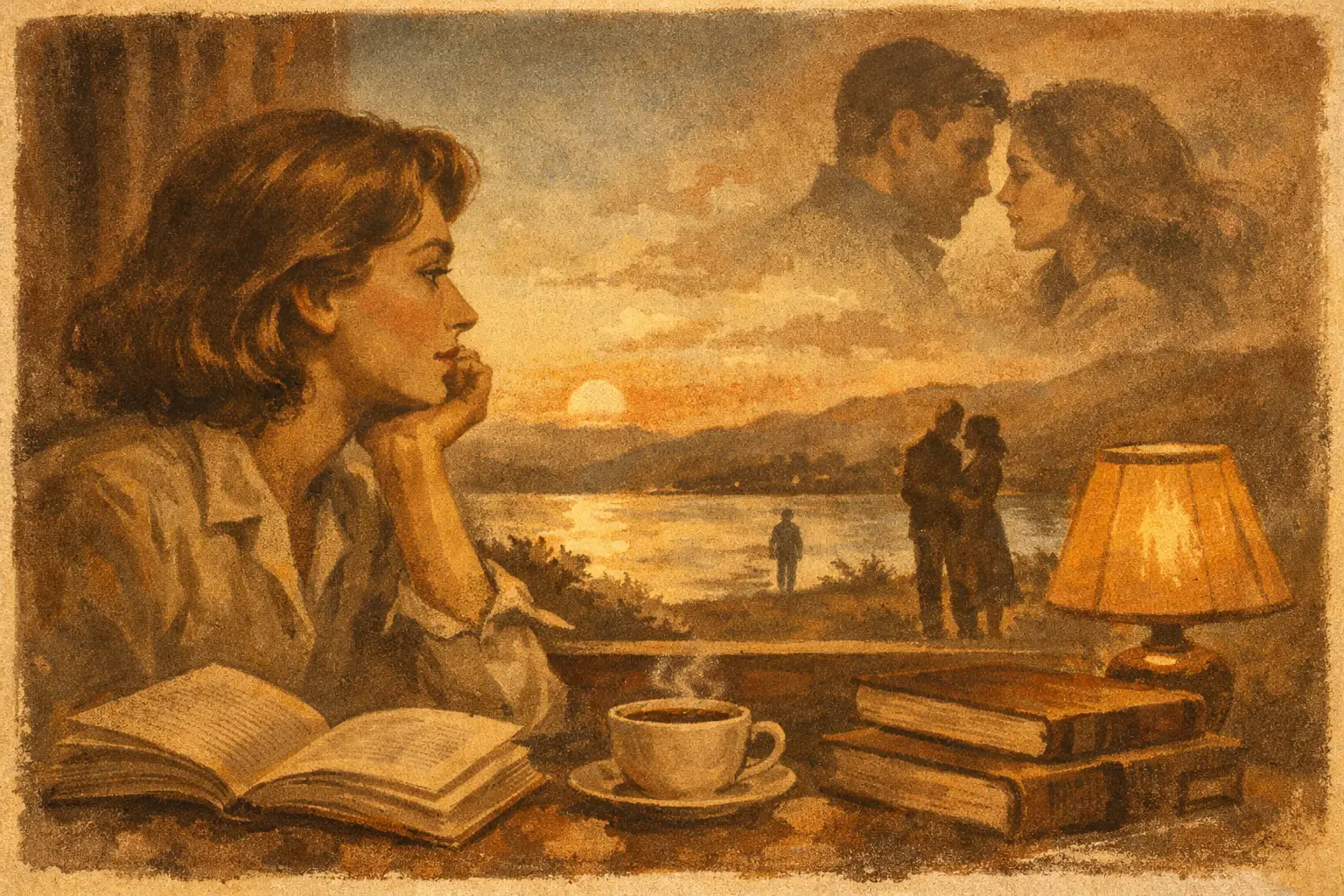
Some novels announce themselves with impact. A body falls, a secret surfaces, a door is forced open. Slow burn literary fiction begins elsewhere – with a footstep in an unfamiliar street, a room observed before it is understood, a silence that seems to hold more than speech. It does not ask to be consumed quickly. It asks for attention.
That distinction matters. For the reader drawn to atmosphere, ritual, and inward movement, pace is not merely a technical choice. It shapes how meaning arrives. In a faster novel, revelation often comes through events. In slow burn literary fiction, revelation gathers through repetition, through objects returning in altered light, through the gradual recognition that a place has been changing the mind of the person moving through it.
What slow burn literary fiction really offers
The phrase is sometimes used too loosely, as if any quiet novel can be placed beneath it. But slowness on its own is not enough. A book is not compelling simply because little happens on the surface. The true slow burn depends on tension of another kind – emotional, philosophical, perceptual. Something is always shifting, even when the shift is nearly invisible.
A traveler enters a city and notices the gate before he understands what the wall protects. Bells ring at dawn, and the sound seems ordinary at first, then gradually reveals itself as part of a larger order. A coin carried across deserts loses its value the moment it changes hands. Nothing here resembles spectacle, yet each detail acquires weight. The reader keeps going not to reach a twist, but to learn what these patterns mean and what they are doing to the person who notices them.
This is where slow burn literary fiction differs from plot-light fiction that simply drifts. It moves, but inwardly. Its momentum comes from accumulation. A courtyard, an incense trail, a polished stone floor, a ritual repeated without explanation – these are not decorative touches. They are the method by which the book teaches the reader how to see.
The pleasure of delayed meaning
Many readers come to literary fiction for language, but language alone cannot sustain a slow novel. What sustains it is delayed meaning. A symbol appears before its significance is clear. A custom is described before its logic is named. A place feels coherent before it feels knowable.
That delay creates a particular kind of intimacy. The reader is not handed conclusions too early. Instead, one lives beside uncertainty long enough for it to become productive. Questions remain open. Why does this city wake as one body at the sound of bells? Why does a stranger’s money suddenly seem empty? Why does order feel comforting in one moment and quietly unsettling in the next?
The answers, when they come, often arrive softly. Slow burn literary fiction rarely builds toward a single dramatic disclosure. It allows understanding to form in layers, the way light changes the color of stone over the course of an afternoon. By the time a reader recognizes what a ritual means, or what a recurring object has been carrying all along, the knowledge feels earned rather than delivered.
That earned feeling is one reason these books linger. They ask the reader to participate in interpretation. Not to solve a puzzle, exactly, but to dwell inside one.
Why atmosphere matters more than speed
Readers who prefer fast-moving fiction sometimes speak of atmosphere as if it were secondary, a pleasing surface laid over the real machinery of story. In the best slow burn literary fiction, atmosphere is the machinery. It is how the novel thinks.
A city of high walls, measured routines, metal windmills turning in bright air, and temple shadows stretching over daily life does more than provide a backdrop. It creates a system of feeling. The reader begins to sense what can be said there, what must remain unspoken, what forms of value are visible, and which ones vanish at the threshold. Setting becomes moral pressure, symbolic texture, and emotional weather at once.
This is why sensory detail matters so much in the form. Dust, stone, incense, bronze, cloth, heat, echoes in a corridor – such details ground abstraction. They keep philosophical fiction from floating away from the body. A novel may ask large questions about belonging, meaning, exchange, and transformation, but it does so through the grain of wood beneath a hand or the sound of sandals on a street at dawn.
When atmosphere is handled with care, the reader does not simply imagine a place. The reader enters its order, and begins, almost without noticing, to think according to its rhythms.
The risk of slowness, and why it is worth taking
Not every reader wants this kind of experience, and not every novel can carry it. Slowness exposes weakness quickly. If the sentences are inert, if the details do not deepen, if the interior movement is thin, the book can feel static rather than absorbing.
That is the trade-off. Slow burn literary fiction asks more from both writer and reader. The writer must make observation active. The reader must accept that gratification may come later, and in subtler forms than plot usually provides.
Yet for the right reader, that exchange is more than fair. It replaces adrenaline with attention. It makes room for books that trust mood, structure, and recurring image. It allows a narrative to become immersive without becoming loud.
There is also an ethical quality to this pace. A slower novel can grant dignity to things fast fiction often passes over – waiting, looking, misreading, adjusting, entering a social world without understanding its codes. These experiences are common in life, especially in moments of displacement. We do not always change in bursts. Often we change by standing in unfamiliar light long enough for our own assumptions to loosen.
Slow burn literary fiction and the question of transformation
Transformation in this form is rarely theatrical. A character may cross a desert, enter a walled city, sleep in a guesthouse, walk through markets, notice silver coins becoming useless, and still appear outwardly composed. But inwardly, perception has begun to shift.
That shift is often the true narrative. The self that arrived is not quite the self that remains. What changes may be language, trust, value, attention, or the ability to live inside ambiguity. The outer world, with its rituals and arrangements, becomes a mirror that does not flatter. It reveals the limits of what the traveler thought he knew.
This is one reason contemplative novels can feel so intimate. Their drama is not absent. It has simply moved below the surface, where recognition, estrangement, and adaptation work slowly against one another.
In a novel like PAI, this kind of movement finds a natural home. The appeal lies not in haste, but in the careful unfolding of a place that seems both ancient and precisely made, where each object and gesture suggests a meaning just beyond immediate reach. The reader is invited to notice before judging, to inhabit before interpreting.
Who these novels are for
Slow burn literary fiction is for readers who enjoy being changed by a book gradually. Readers who do not mind pausing over a paragraph because its cadence matters. Readers who find suspense not only in danger, but in pattern – in bells that return, in doors that open onto courtyards, in the feeling that a city’s logic is becoming visible one small sign at a time.
It helps if you read for texture as much as for event. It helps if you like novels that trust silence, and that leave certain meanings partially open. But even then, taste is not fixed. Sometimes a reader comes to a slower book after growing tired of narratives that explain too much and move too quickly. What once felt patient begins to feel generous.
And perhaps that is the quiet power of the form. It restores the dignity of attention. It reminds us that not every meaningful journey is marked by collision. Some are marked by observation, by repetition, by the slow rearranging of value inside a mind.
If a novel asks you to walk rather than run, it may be asking for something better than speed: the chance to notice what only appears when the dust settles, the bells carry across the air, and the unfamiliar world begins, almost imperceptibly, to feel legible.
Leave a Reply