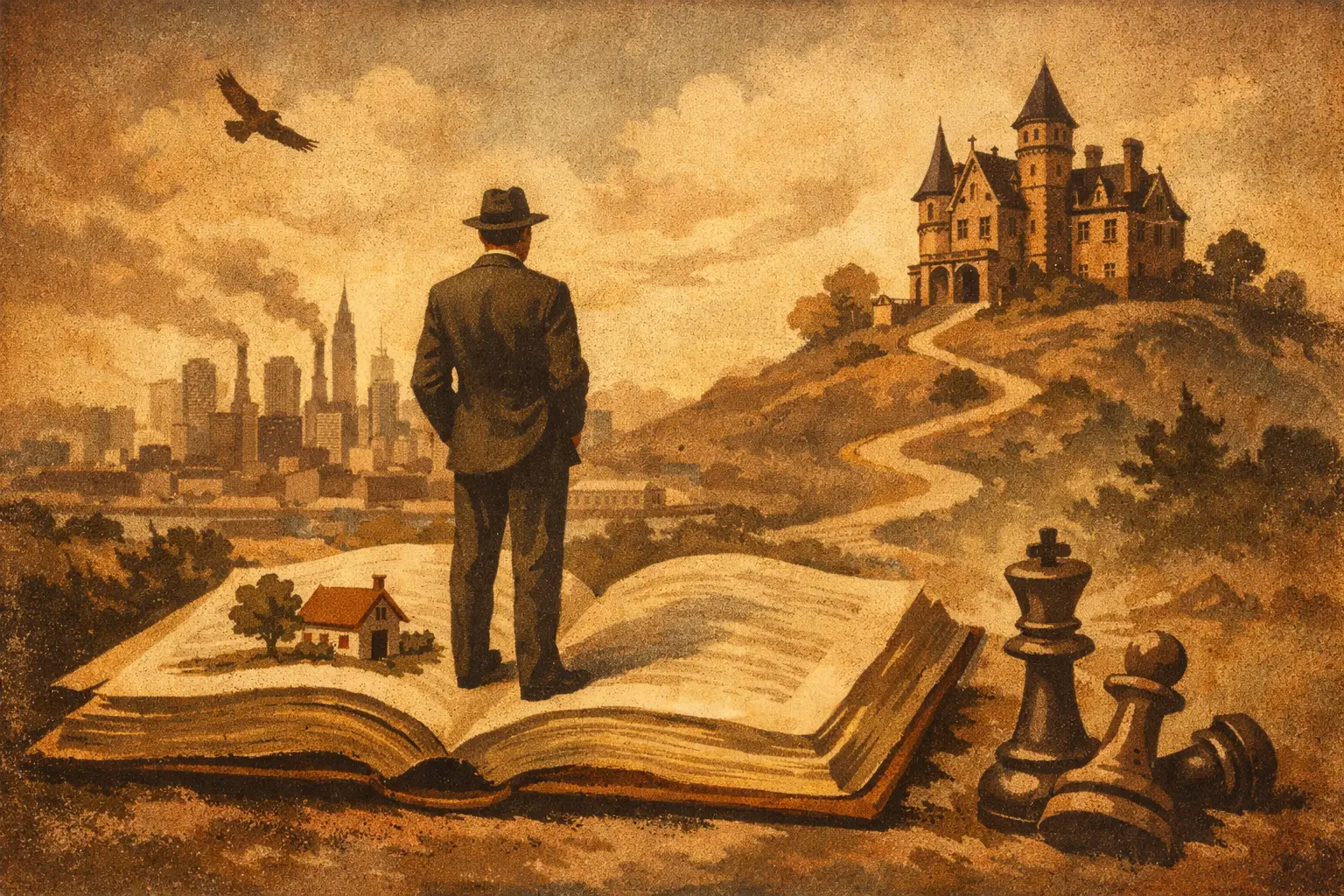
Some novels announce power with a throne, a decree, a battlefield. Others let it gather more quietly, in stone corridors, in thresholds, in the way a bell can order a morning before a single word is spoken. The most memorable symbolic novels about power and place understand that authority is rarely abstract. It settles into architecture, into ritual, into gates and rooms and distances. It teaches people how to move, what to notice, and what to accept as natural.
This is part of what makes such novels linger. They do not treat setting as backdrop. Place is the argument. A city wall, a desert road, a temple court, a narrow market lane – these are not decorative surfaces laid behind the human drama. They are the form that power takes when it becomes ordinary enough to feel eternal.
Why symbolic novels about power and place stay with us
A symbolic novel asks the reader to notice patterns before explanations. A stairway may matter before we know why. A coin may pass from hand to hand and reveal less about wealth than about belonging. A tower seen at dawn may feel less like a landmark than a sentence spoken by the city itself.
Power, in these books, is often most visible where no one names it. It appears in choreographed routine, in accepted silence, in who may enter and who must wait. Place gives that power shape. Without place, authority can feel theoretical. With place, it becomes tactile. You can hear it in metal striking the hour. You can feel it in polished stone worn smooth by generations of feet following the same path.
That is also why these novels tend to move at a measured pace. A hurried narrative can show conflict, but it rarely allows a reader to inhabit a system. Symbolic fiction, especially literary fiction rooted in atmosphere, often slows down so the reader can sense how an environment educates perception. The point is not merely what happens in a city, an estate, or a remote settlement. The point is what that place makes possible, and what it quietly forbids.
Place is never neutral
In weaker fiction, a city is interchangeable with any other city, a house with any other house. In more thoughtful work, place carries memory and instruction. A wall divides more than inside from outside. It creates an idea of safety, exclusion, order, and fear, sometimes all at once. A garden can suggest cultivation, but also containment. A road can promise freedom while exposing the traveler to hunger, weather, and doubt.
This is where symbolism earns its weight. The physical world in a novel becomes charged with moral and political meaning, but not in a blunt or allegorical way. The best examples resist simple decoding. A temple may signify spiritual authority, civic hierarchy, and private longing at the same time. A marketplace may represent exchange, but also misunderstanding – especially when value itself is unstable.
That instability matters. One of the richest themes in symbolic fiction is the shock of entering a place where familiar measures lose their force. Money no longer spends. Language slips. Gesture fails. The traveler, exile, or newcomer discovers that power lives not only in rulers, but in shared systems of meaning. To be outside those systems is to become vulnerable in ways both practical and existential.
The city as a living structure of meaning
Many of the finest literary works use the city as more than scenery. The city becomes a text that must be read, though never fully mastered. Streets curve with intention. Public sounds regulate private time. Buildings concentrate values that people no longer need to speak aloud because stone has already spoken for them.
This kind of setting does not simply host the plot. It forms the consciousness of everyone inside it. Even the stranger, upon entering, begins to adjust his pace to the local rhythm. He watches before acting. He learns that observation is a kind of survival.
Readers who are drawn to contemplative fiction often recognize this pleasure immediately. The pleasure is not suspense in the ordinary sense. It is immersion. It is the slow realization that every object has been placed within a larger order, and that the order itself may be beautiful, oppressive, sacred, or some uneasy combination of all three.
Power in symbolic fiction is often quiet
Modern discussions of power tend to favor the obvious: violence, command, wealth, spectacle. Symbolic novels frequently turn elsewhere. They attend to softer forms of control, the ones that seem benign because they are woven into daily habit.
A bell can be one such symbol. It marks time, but it also gathers bodies into obedience. A uniform can provide identity, but it can just as easily erase difference. A ceremonial object may appear ornamental while carrying the authority of a tradition no individual feels able to question. In these moments, symbolism allows fiction to say something precise without narrowing itself into thesis.
Still, there is a trade-off. Symbolic novels ask more from the reader than plot-driven fiction does. They require patience with ambiguity. They often refuse to explain themselves on schedule. For some readers, that feels revelatory. For others, it can feel withholding. But when the balance is right, that restraint is exactly what gives the work its depth. Meaning arrives gradually, like light shifting across a courtyard wall.
When landscape becomes authority
Not all power is urban. In many novels, landscape itself acts on the human spirit. Deserts strip away certainty. Mountains humble ambition. Rivers draw borders while suggesting passage beyond them. A barren road can become an instrument of inner transformation because it removes the distractions that made the self legible.
Yet landscape in symbolic fiction is rarely just psychological weather. It often frames civilization by contrast. The road outside the city wall sharpens the city’s logic. The wilderness tests the rituals of settlement. The threshold between open land and enclosed order becomes one of the most potent symbolic sites in literature because it stages the old question: who belongs here, and at what cost?
What readers often look for in these novels
Readers who love this mode of fiction are usually not searching for constant event. They are looking for atmosphere that carries thought. They want to feel that objects matter, that buildings remember, that ritual can reveal a philosophy before any character tries to explain it.
They also tend to value uncertainty. Not confusion for its own sake, but the productive uncertainty of entering a coherent world whose rules are only partly visible. In that space, every small detail acquires pressure. A silver coin with no local value can become more revealing than a speech. A windmill, a gate, a guesthouse, a public square – each may hold a clue to how power circulates and how identity is granted or denied.
This is one reason a novel like PAI finds its place among readers of reflective literary fiction. Its interest lies not in dramatic revelation but in the felt experience of passing into a city shaped by ritual, architecture, and quiet order. The traveler does not conquer the place or decode it all at once. He observes. He absorbs. He gradually senses that value, belonging, and authority are embedded in the material life of the city itself.
How to recognize a strong symbolic novel about power and place
A strong novel of this kind does not use symbolism as decoration. Its symbols alter the reader’s understanding of the world they inhabit. Place should feel active, not painted on. The setting should influence behavior, thought, and emotion at every level.
It also helps when the novel trusts image over explanation. If every symbol is translated for the reader, much of the mystery evaporates. But if nothing is anchored, the work can drift into vagueness. The art lies in tension: enough clarity to orient, enough silence to invite reflection.
The most affecting books also understand that power is not singular. It can shelter and confine. It can create beauty and obedience in the same gesture. A highly ordered city may feel graceful from one angle and unforgiving from another. Symbolic fiction becomes richer when it allows these contradictions to remain visible.
And finally, the prose matters. Because these novels rely so heavily on atmosphere, language must carry weight without becoming ornamental for its own sake. The sentence should move like a careful gaze across stone, cloth, light, and shadow, alert to the fact that description is never only description.
A good symbolic novel leaves you more attentive to the places you already inhabit. After reading one, a gate no longer seems just a gate. A public square feels arranged by old decisions. A wall begins to ask whom it protects and whom it keeps outside. That may be the quiet gift of this kind of fiction: it returns the visible world to us, but charged with meaning, and asks us to walk through it more carefully.
Leave a Reply