


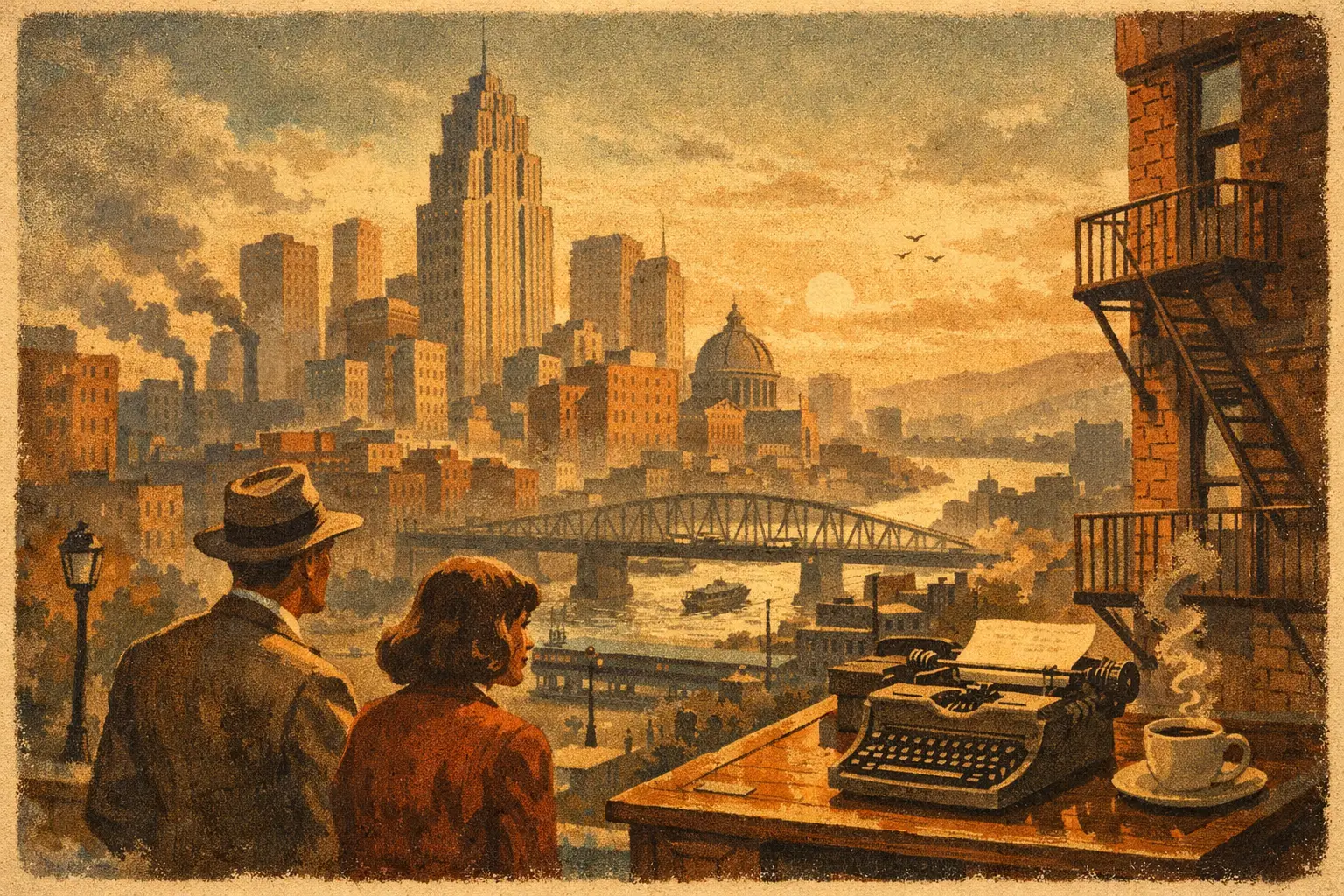
Some cities enter a story the way a person does – with habits, moods, silences, and a force that changes everyone who comes near. You can feel it early, often before the plot declares itself. A street narrows. Bells sound at the same hour each day. Dust settles on stone in a way that suggests age, patience, and order. When readers look for examples of city as character, they are usually looking for this precise effect: a place that does more than contain events, a place that acts.
This is not the same as vivid setting. A well-described town may still remain background, however beautiful it is. A city becomes a character when its logic presses against the people inside it, when its architecture, customs, weather, distances, and hidden rules shape desire, fear, memory, and choice. The city begins to feel less like scenery and more like a presence with its own temperament.
What makes a city feel like a character?
Usually, it begins with pressure. The city does not simply exist. It asks something of those who enter it. It slows them down, confuses them, disciplines them, seduces them, or remakes their sense of value. In literary fiction especially, this pressure is often subtle. It may arrive through ritual rather than spectacle, through recurring sounds, thresholds, courtyards, markets, walls, bridges, mist, heat, or a pattern of movement that quietly governs daily life.
A city-character also has continuity. It seems to have lived before the protagonist arrived and will go on living after that person leaves. Its systems feel older than any single scene. Its people may only partly understand it. That mystery matters. If everything about a city can be explained in a paragraph, it rarely feels alive for long.
There is a trade-off here. The more a writer leans into the city as character, the less the story may rely on conventional plot momentum. For some readers, that creates immersion. For others, it can feel too still. But for novels and films interested in perception, belonging, exile, class, memory, or spiritual drift, the city-character offers something few other devices can: an entire world that answers back without always speaking plainly.
12 examples of city as character
1. Venice in Death in Venice
Venice is not a neutral backdrop in Thomas Mann’s novella. It decays, glimmers, sickens, and tempts. The canals and damp air create not only atmosphere but moral and psychological pressure. The city becomes inseparable from Aschenbach’s unraveling, as if its beauty and rot are working on him together.
What matters here is contrast. Venice is exquisitely composed on the surface, yet underneath it carries contamination and collapse. That double nature gives it a distinctly human quality.
2. Dublin in Ulysses
Dublin has routine, memory, appetite, and sound. In James Joyce’s hands, the city is so specific that walking through it feels like entering a mind. Streets, pubs, shoreline, advertisements, churches, and fragments of conversation form a living structure around Leopold Bloom’s wandering.
Dublin does not merely frame consciousness. It produces it. The city thinks through repetition, commerce, ritual, and public life.
3. St. Petersburg in Crime and Punishment
Heat, crowding, poverty, narrow rooms, bridges, alleys – St. Petersburg presses on Raskolnikov from every side. The city is feverish. It intensifies guilt, paranoia, and alienation until moral crisis begins to feel architectural.
This is one of the clearest examples of city as character because the urban environment behaves almost like an antagonist. It corners the mind. It leaves little room to breathe.
4. London in Bleak House
Dickens gives London fog not just as weather but as condition, judgment, and texture of thought. Chancery, soot, mud, wealth, disease, and bureaucracy gather into a city that feels sprawling yet intimate in its power.
London’s personality is diffuse but unmistakable. It obscures, delays, and entangles. People move through it, yet they are also absorbed by its systems.
5. Alexandria in The Alexandria Quartet
In Lawrence Durrell’s work, Alexandria is sensuous, unstable, layered with desire and political uncertainty. It is a city of mirrors and shifting perspectives, never fixed for long. The same streets seem to change as relationships change.
That instability is the point. A city-character does not have to be consistent in a simple way. It can be elusive, contradictory, and difficult to know, much like a person glimpsed through memory and longing.
6. Istanbul in The Museum of Innocence
Istanbul in Orhan Pamuk’s novel is thick with melancholy, class codes, domestic interiors, shorelines, shops, and objects that seem to absorb feeling. The city is not loud in its influence, yet it shapes the emotional terms of love, shame, and remembrance.
Pamuk understands that a city can become a character through objects as much as monuments. Teacups, apartments, streets at dusk, and neighborhood habits all contribute to a civic soul.
7. Macondo in One Hundred Years of Solitude
Macondo is fictional, but it behaves like a city or town with a destiny. It grows, remembers, suffers, forgets, and transforms through cycles that feel almost bodily. Weather and history move through it with the force of inheritance.
Because it is invented, García Márquez can make the place highly symbolic. Yet Macondo never feels abstract. Its dust, heat, insomnia, and repetition give it weight and pulse.
8. New York in The Great Gatsby
Gatsby’s New York, including its edges and adjoining zones of wealth and waste, gleams with appetite. This city invites performance. It makes reinvention seem possible and emptiness easy to hide. The ash-gray spaces beyond the parties matter as much as the champagne-lit rooms.
New York here has charisma, but it also has carelessness. It offers speed, spectacle, and social ascent while quietly exposing their cost.
9. Casablanca in film noir, especially Casablanca
Some cities become characters through atmosphere first. Casablanca is built from transit, rumor, smoke, uniforms, waiting rooms, gambling tables, visas, and doors that may open or stay closed. It is a city defined by passage and delay.
That makes it emotionally active. Characters do not simply live there. They are held there, tested there, suspended between departure and attachment.
10. The unnamed city in Invisible Cities
Calvino’s cities are many, yet each often feels like a distinct consciousness. They are made of memory, desire, signs, absence, repetition. Though they are described with delicacy, they leave a strong impression of will.
This is a useful reminder that realism is not required. A city can become a character even when it is impossible, provided it carries internal coherence and emotional consequence.
11. Yoknapatawpha’s Jefferson in Faulkner’s fiction
Jefferson is shaped by race, memory, land, violence, inheritance, and gossip. The town feels watchful. Its houses, roads, and public spaces preserve old wounds and enforce social order.
A city-character can emerge not from spectacle but from accumulated history. Here, place has the density of judgment.
12. The city in PAI
Sometimes the strongest city-characters are not named too clearly, as if a proper noun would reduce their power. In PAI, the city is entered through gates, stone, ritual time, metal windmills, ordered streets, incense, temple presence, and a social rhythm that the traveler must learn before he can even begin to understand value. The place does not announce itself with noise. It reveals itself by pattern.
That restraint is what gives the city its force. Bells awaken a population together. Architecture directs attention. Coins lose meaning when they cross the threshold into a different system. The city feels calm, but its calm is not passive. It examines the stranger as much as he observes it.
Why these examples of city as character stay with readers
We remember such cities because they reorganize inner life. A character may enter with one set of assumptions and leave with another, or fail to leave unchanged at all. The city becomes the medium through which transformation occurs. Not by lecture, and not always by dramatic event, but through repeated contact with walls, markets, stairways, ceremonies, distances, and rules that must be felt before they can be understood.
That is why city-characters often appear in works concerned with exile, pilgrimage, moral uncertainty, or social performance. The city makes abstraction tangible. It turns questions of belonging, power, class, faith, and desire into something you can smell in the air or hear in a corridor.
How writers build a city as character
The most effective approach is rarely excess description. It is selective recurrence. A writer returns to certain sounds, materials, thresholds, and habits until they gather meaning. Stone may begin as surface and end as philosophy. A bell may begin as sound and end as authority. A market may begin as commerce and end as a map of social order.
It also helps when the city resists total explanation. Readers should sense an order larger than the protagonist’s current understanding. Curiosity is part of character. So is limit.
If you are reading with care, the question is simple: does the city change the terms of perception? If it does, then it has already stepped beyond setting. It has begun to live beside the people on the page, watching them, shaping them, and quietly asking who they will become within its walls.
Leave a Reply