


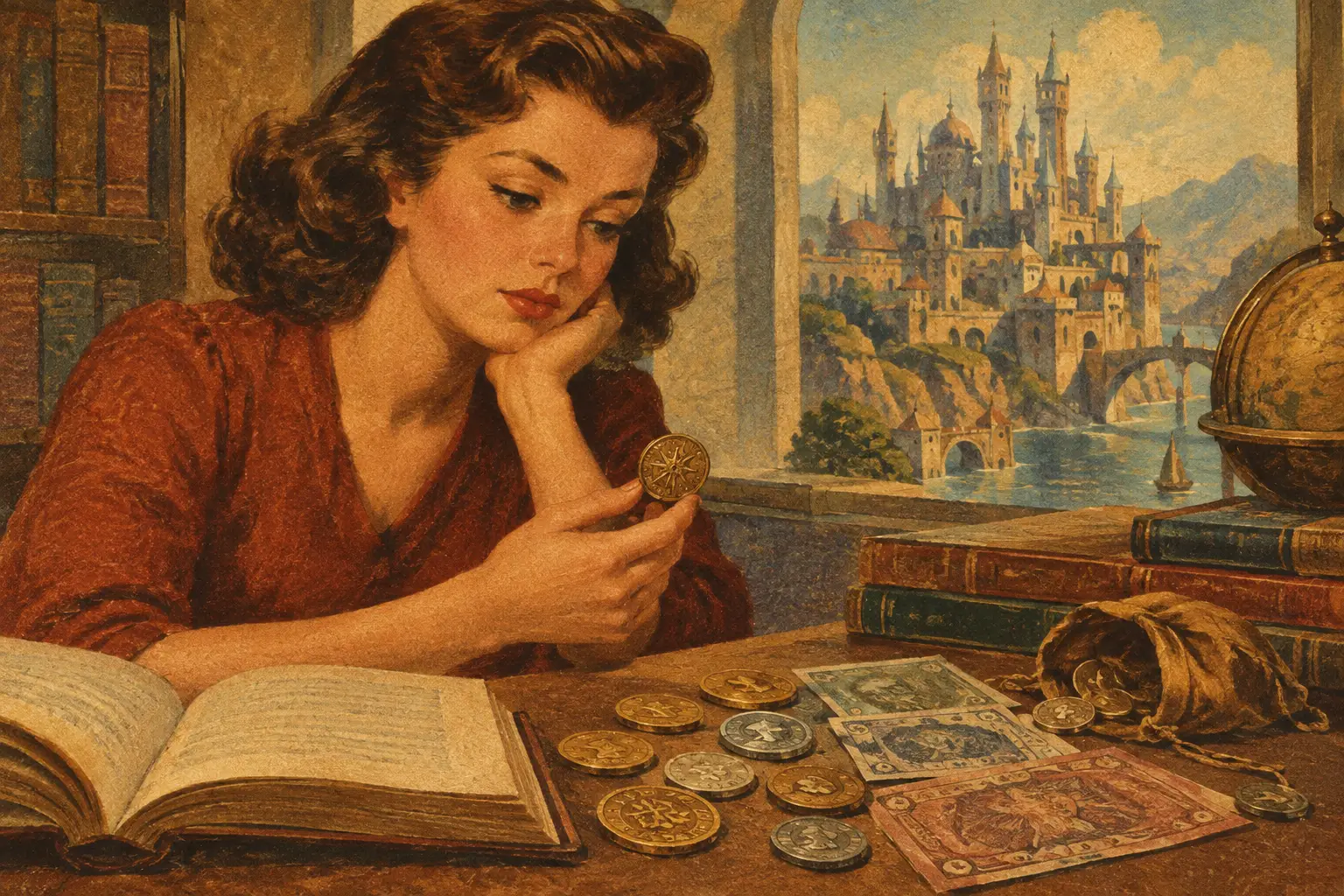
A coin is never only a coin. In a strange city, it may gleam in the traveler’s palm like a fragment of home, yet mean nothing at the market stall. To learn how to interpret fictional currencies, begin there: not with conversion rates, but with the unsettled distance between an object’s apparent worth and the meaning a place permits it to hold.
Literary fiction often uses money quietly. A purse is opened, weighed, refused, hidden beneath cloth, or passed across a polished counter. These small gestures can reveal a society’s deepest arrangements: who is trusted, what labor is honored, which institutions command belief, and who remains outside the gate. A fictional currency is part of a world’s weather. It moves through rooms, rituals, and silences, carrying the atmosphere of its origin.
How to Interpret Fictional Currencies Beyond Their Price
The tempting question is usually practical: What would this coin buy? Sometimes the text gives an answer, and it can be useful. The price of bread, lodging, transport, or a night’s protection helps establish material conditions. But price alone rarely explains why an invented currency matters.
Ask instead what happens when it appears. Does a merchant touch it with reverence or suspicion? Is it counted openly, or does it disappear into an inner pocket? Does a character inherit it, steal it, offer it at a shrine, or refuse it despite need? The answer tells you more than a precise exchange table could.
In a tightly ordered city, a silver piece may fail because it bears the wrong sovereign’s face, comes from beyond familiar roads, or lacks the blessing of a temple. Its metal remains real. Its purchasing power does not. That difference is one of fiction’s most revealing lessons: value is never fully contained in the object. It is made between people, upheld by habit, authority, and mutual recognition.
A reader does not need to solve every denomination. In fact, excessive calculation can flatten a symbolic object into a prop. Notice the coin’s weight, its worn edge, the sound it makes against stone. Then notice the human response it draws forth. The world is explaining itself through that response.
Read the Material Before the Number
The substance of a currency often matters before its amount. Gold suggests one set of associations, silver another; paper, shells, salt, stamped clay, carved wood, and measured grain each bring their own histories of scarcity, durability, ceremony, and control.
Yet these associations should remain tentative. Gold can signify royal splendor, but it can also expose fear, greed, or an older system losing its force. A plain iron token may be humble in appearance and central in practice. Its worth depends on the story’s own conditions.
Look closely at what the currency is made to endure. Metal survives a journey across deserts and mountain passes. Paper can be fragile, official, and dependent on institutions that honor its marks. Perishable goods must circulate quickly, tying value to season and proximity. When an author chooses a material, the choice can reveal what a society believes will last.
The marks on the object matter too. Portraits, animals, sacred geometry, dates, inscriptions, and unfamiliar scripts are not decoration alone. They announce who claims the right to certify value. A ruler’s profile says that power has a face. A temple seal suggests that trade and belief share a foundation. An unmarked coin may imply an older custom, a hidden economy, or a value rooted in weight rather than command.
Follow the Currency Through Ritual and Daily Life
Money becomes legible when it moves. Watch where it is accepted and where it is not. A city may welcome coins in its markets but forbid them inside a sanctuary. Soldiers may receive stamped pieces while artisans are paid in provisions. A guesthouse may ask for a gift rather than a fee, making hospitality feel less like a transaction and more like an obligation.
These distinctions show that no economy is singular. Most fictional worlds contain overlapping systems of value: official currency, favors, family duty, religious offerings, reputation, knowledge, and access. A person can be rich in one system and helpless in another.
This is especially true for travelers. The traveler arrives with wealth that has already been recognized elsewhere. Perhaps the silver is valuable on the road, where its shine can buy fodder or passage, but strange inside the city wall. His difficulty is not merely financial. It is perceptual. He must learn which gestures count, which objects carry authority, and whom to approach without causing offense.
In PAI, unfamiliar silver coins carry precisely this tension. They are tangible, carefully preserved, and seemingly valuable, yet they cannot speak for their owner in a city whose order has been shaped by other rites. The coins become a quiet measure of displacement. They ask whether possession can offer belonging when the surrounding world does not recognize its language.
Notice Who Is Allowed to Name Value
Every currency has guardians, whether visible or hidden. Sometimes they are monarchs, banks, guilds, tax collectors, or temple officials. Sometimes they are market women who can identify a false weight by touch, or elders whose approval gives an exchange its legitimacy. Fictional currencies become richer when you ask who has the authority to say, “This counts.”
Authority may be centralized, but it does not have to be. A highly controlled currency can suggest an orderly state, reliable roads, taxation, and careful records. It can also suggest surveillance and dependence. A decentralized barter system may feel intimate and adaptive, but it can exclude outsiders who do not understand local ties. Neither system is automatically virtuous.
Pay attention to counterfeiting, debt, and hoarding as well. A counterfeit coin is a challenge to official faith. Debt can bind people more tightly than chains, particularly when its terms are obscure. Hoarding may signal scarcity, distrust, or a coming rupture in the social order. Even when these elements remain in the background, they can cast a long shadow over a scene.
Treat Refusal as a Form of Worldbuilding
The refusal of money is often more meaningful than its acceptance. It may indicate that a character cannot be bought, but it can also expose insult, hierarchy, or a rule the outsider has failed to see. A payment offered at the wrong moment can turn gratitude into humiliation. A gift accepted too quickly can create an obligation neither person has named.
Read these moments slowly. What does the refusal protect? A sacred boundary? Professional pride? A custom of mutual aid? Or the power of those already inside the system?
The emotional temperature matters. A calm refusal differs from a fearful one. Laughter at an unfamiliar coin differs from contempt. A merchant who pauses before accepting payment may be calculating risk, remembering an old decree, or recognizing something rare. Fiction does not always explain the pause. It asks the reader to remain with it.
Let Uncertainty Remain Part of the Meaning
A fully mapped fictional economy can be satisfying, particularly in expansive fantasy or political fiction. But literary worlds often work by partial illumination. You may never learn the exact value of a silver coin, the history of every seal, or the logic behind a private exchange. That absence can be deliberate.
Uncertainty places you beside the character who has entered a place without its codes. It turns reading into an act of attention. Rather than demanding immediate clarity, you begin to feel the pressure of a system before you understand its rules: the bell heard at dawn, the guarded doorway, the measured glance at a foreign object.
When a fictional currency appears, hold it in the mind as the traveler holds it in the hand. Feel its weight, but also its limitation. Its true worth may not be what it purchases. It may be the question it leaves behind: what, in this place, allows one person to be recognized by another?
Leave a Reply